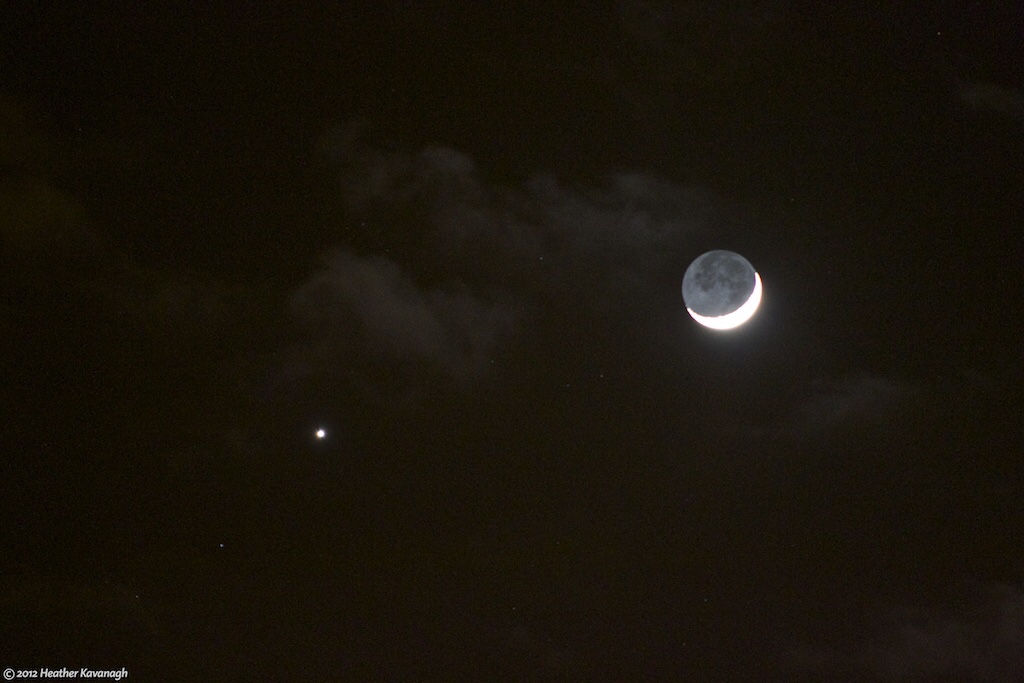
Have you noticed the Moon? It’s our home planet’s natural satellite. According to current thinking, it was created by a collision between the very young Earth and a sibling protoplanet during the Solar System’s formative millennia, some four thousand million years ago.
Without the Moon, which was much closer to Earth millions of years back and has been slowly shifting further away in its orbit, it is thought unlikely that life as we know it might have begun and been nurtured here. Earth’s oceans have tides caused by the tiny gravitational pull of our nearest celestial neighbour.
The Moon has been humanity’s constant companion, observed by our ancestors whenever the night sky was clear. The phases from full to full, where the face is fully lit by the Sun, take roughly twenty-nine days to cycle through. That is where we get our calendar months from, among other things.
By some happenstance, the Moon is locked in its orbit around us so that we see only one face. The far side was hidden from us until we had learned to launch spacecraft that could travel out there and see for us. While it has been just over fifty years since we sent men to stand on the surface, various space agencies have been sending probes to investigate and learn about the Moon, with a view to returning there as a stepping stone for crewed missions further into the Solar System. The American space agency, NASA, is building up to sending a crewed mission there in a couple of years. Most recently, the Chinese and Indian space agencies have sent landers and rovers; Japan has a high-resolution imaging orbiter that’s been recording the Moon’s surface in incredible detail; just this past month, NASA sent a lander which landed and fell over, while Japan sent a probe that accidentally face-planted on the surface.
All this verbiage is because I have begun to notice an increase in silly names for the full Moon. I mean, it happens every month, so why give it names at all? When I was younger, there was a Harvest Moon. This is the full moon closest to the autumnal equinox, and generally coincided with the late summer or early autumn period when a bright full moon would be most helpful when gathering in the wheat, and making the most of dry weather. Hunter’s Moon is the first full moon after the Harvest Moon. I was aware of something called a “bomber’s moon”, a full moon on a clear night aiding navigators in wartime bomber aircraft to find their targets. There is also a Blue Moon, which disappointingly isn’t anything to do with colour but merely denotes an occasional full moon twice within a calendar month.
So where did all these silly names, such as Wolf Moon or Strawberry Moon come from?
As ever, I turned to Wikipedia. There is a page all about the full moon, because of course there is. It appears the strange names can be traced back to publication of an American famers’ almanac during the 1930s. The writers seem to have picked up Native American names for full moons, which doubled as lunar month names for native peoples. As these thing happen, the silly names have become more common currency thanks to the internet, and they turn out to be not so silly after all.
So, there you are. I don’t mind if you want to talk about a Worm, Sturgeon or Beaver moon. Like the Moon itself, they have a long pedigree.