Google, like hoover, has become a commonplace word to mean “internet search”. In the beginning it was simple, proud to give search results in fractions of a second. The company even had a motto: do no evil. Other search engines have since bowed to the inevitable. Google über alles.
Now? The motto is long gone. Alphabet, the parent corporation, is enormous with tentacles spreading into everything. Search results, initially just full of advertising, are now becoming garbage regurgitated by so-called artificial intelligence.
Large Language Models based on scraping content with permission or not, mostly not, are being shoehorned into everything. We are being encouraged to enter discourse with our text editors and email clients, letting the machine write, and read, everything for us. We are being threatened with AI doing our shopping. There’s AI in washing machines, coffee makers, footwear. Goodness, what a nightmare! I don’t want it, or need it. We are already beginning to drown in AI slop, unable to trust anything one sees, hears or reads on the internet.
Don’t get me wrong, I can see a place for LLMs. In science and medicine, algorithms that can crunch through huge amounts of data and see the patterns, provide solutions, or suggest new drugs, for example. We really don’t need this running our online lives, though.
Google has announced it’s changing the way it will search. Read more here, on Stuff, and TechCrunch. No longer will the user get an ordered list of links, based on their request. Instead, there will be an interpretation of the content, presented as if it were an actual web site page. No obvious hyperlinks—which the World Wide Web was all about—just the content the algorithm thinks you need, regurgitated and reordered, leaving out the original content maker in the process.
The funny thing is I think most people, at least those clued-up, really don’t want LLMs in their lives. Noting all the noise about this development on my social media feeds, I was reminded of something. Cue the wibbly-wobbly timey-wimey visual effect…

In 1973, my parents acquired a book. Pears’ Cyclopædia, 82nd edition. First published in 1897, the Cyclopædia was a single volume, printed roughly annually.

The flyleaf blurb begins: “No work of reference, however compendious and however well-established, can ever afford to stand still. Change is the dominant feature of our times.” In the back, it says: “Pears is designed not only to impart knowledge but to encourage a spirit of enquiry.”
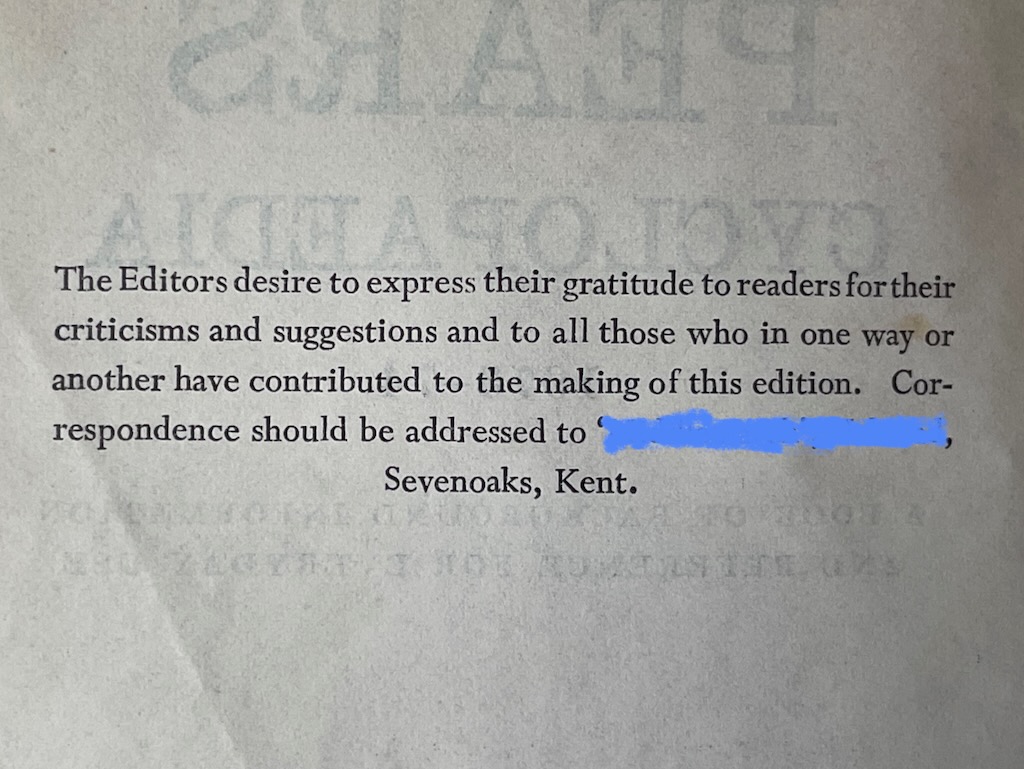
Much like Wikipedia, which I suppose could be seen as the spiritual successor to the Cyclopædia and other printed encyclopædias of the past, the editors were happy for the readers to offer suggestions and criticism. I have redacted the mailing address for privacy reasons.
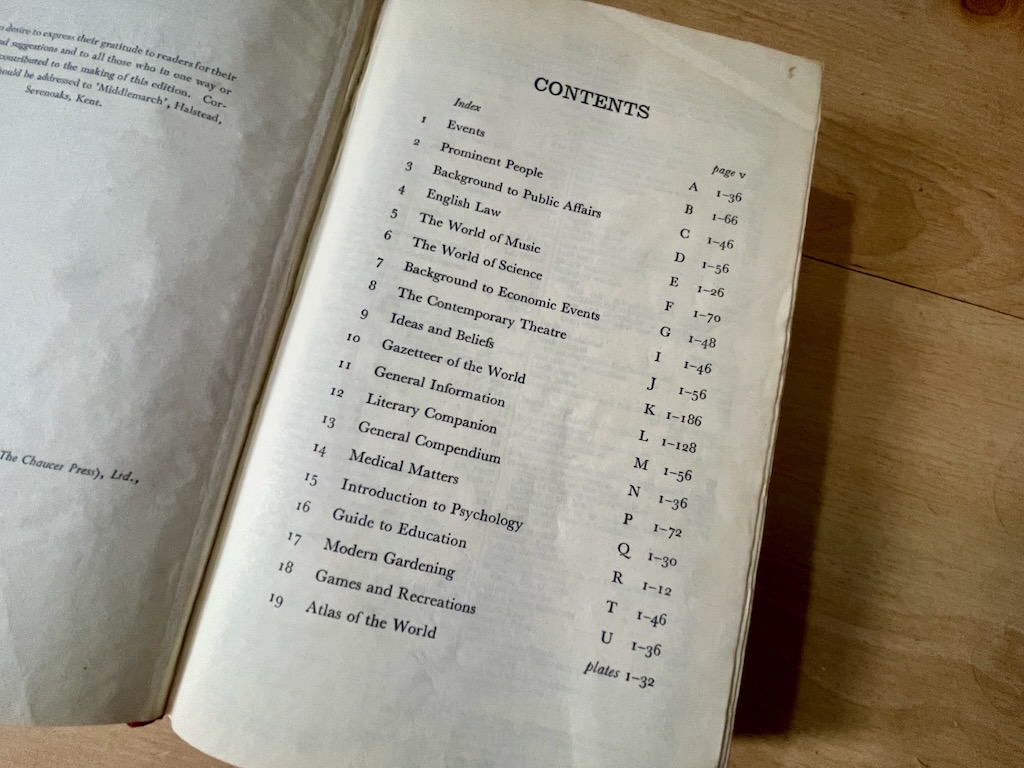
It is, literally, the World Wide Web in paper form. Just look at the contents page! Obviously, 50 years on, a lot of the current affairs are well out of date. I can guarantee quite a lot of the technical and medical stuff has moved on, too. However, as a good overview of the world as it was in 1973, this one volume couldn’t be beaten.

When I was growing up, as well as your bog standard encyclopædias, I was reading this volume. Nine-year-old me was soaking up all kinds of information. I well recall a family camping holiday where I took the Cyclopædia as my main reading material. I was probably 13 at the time, reading up on the current state of the Sciences, and then going on to the Introduction to Psychology. What a nerd!
Yes, I learn today, it was originally promoted by the Pears’ Soap company. The first volume in 1897 cost a shilling. Sadly, Pears’ Cyclopædia is no more, probably inevitably seen off by the World Wide Web. The final edition was published in 2018, after 125 years.
I asked my Nana and Grandad for a Pears Cyclopaedia and a Chambers Concise Dictionary for my 18th birthday and I took both books to university (well, Polytechnic) with me. With those two volumes I could find out nearly everything I needed to know.
At home we also had a copy of The Complete Self Educator from the 1940s and the 4 volume Odhams Young People’s Encyclopaedia which, I believe, Mum had received for a significant birthday or achievement.
Mum and Dad would always try their best to answer my questions but the expectation was usually that I would look things up in our own books and then, if necessary, go to the library!
The wonderful thing is so much of the book is still relevant to the present. Yes, science and medicine have moved on, as have various countries in the gazetteer, but general knowledge and historical events are still fine.