In Part Two, I had fun learning new ways to record noise. It was entirely “studio” based, though. My interest in audio continued during the late 1980s, but life was sort of getting in the way. Eventually, things settled, and I met Best Beloved. Happily, he shared so many of my interests it was really easy to rekindle the audio side of my world. In addition, we could add video to it as well.
The early 1990s was a period of change in many ways. Technology was moving on apace, particularly with the rise of the home computer. While the decade began with analogue home video editing – literally playing back recordings in real time onto a second or third recording deck, editing using the pause controls, with all the loss of quality such things entailed (see also audio recording!) – moves were beginning to be made in using software to edit home video. Such things as Sony’s Video8 format, derived from their larger Betamax system and released in the mid-1980s, and various flavours of VHS, were incrementally improved to provide the best quality original recording as possible. Getting those recordings on to a PC meant further edits would be digital, suffer no loss of quality, and the final edit would be recorded on to another video cassette system. Hi8 and S-VHS were the pinnacle of analogue home video, until the development of digital recording. Even so, a digital video tape still needed to be played back in real time, either to another deck for manual editing, or into a computer for digital editing. The possibility of recording video to a file on a disk or some solid-state memory was still a way off.
Home audio systems didn’t go through quite so many changes. After the Sony and Philips collaboration on the compact disc, the need for domestic high quality recording mechanisms seemed to dissipate. Instead, much effort was expended in making analogue cassette tape recorders better. Digital recording was still very much only found in music recording studios, and still used tape.
Nascent pop stars could, of course, record their own music on tape. To do it properly several manufacturers, such as Tascam, Yamaha and Fostex, produced reel-to-reel and cassette decks that could record multiple tracks, and provide rudimentary mixing. Best Beloved decided he’d like to try one out, for audio mixing purposes, so we acquired a Fostex Multitracker X-28 from a local music shop.
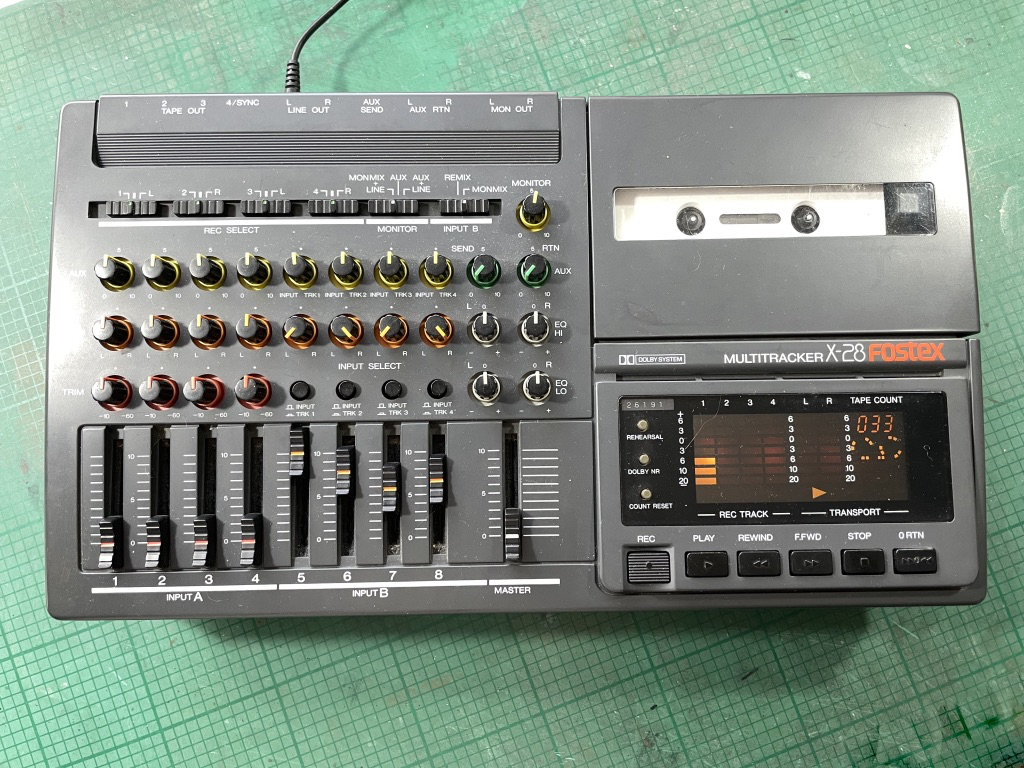
The Fostex X-28 is an ultra-compact 4-track recorder, running at standard tape speed, which can record four tracks simultaneously from up to eight inputs. It features a soft-touch control transport, Dolby noise reduction, stereo 2-band EQ, and effects routing and controls.
Thanks to reverb.com for that. It’s nice to know working used 30-year-old X-28s are still reaching close to their original retail prices.
The Fostex and its ilk were probably the apex of analogue studio recording gear. Analogue was still king in film and television, as well as radio, for quite a while. Sony certainly produced some high-end cassette-based field recorders used by journalists and film makers. Of course, the switch to digital, and particularly the availability of inexpensive flash memory, has changed the game completely.
I keep mentioning Sony. The reason for that is a lot of their technology found its way into my hands during the 1990s.
In an effort to get ever better sound recordings – as Best Beloved was just as interested in recording the audio world around us as I was – a good while was spent investigating the possibilities of the Sony Video8 and Hi8 systems as audio recorders. Eventually, Best Beloved settled on a portable battery-operated Video8 system from Sony. It was called the Walkman GV-U5E, and was essentially the guts of a camcorder without the optics. It could be mated with a simple camera, but our interest was in using it purely as an audio recorder. You see, Video8 and Hi8 used PCM (pulse-code modulation) audio recording, recorded alongside the legacy analog stereo soundtrack to the video, giving a sampling rate of 32 kHz with 8-bit samples. Digital sound recording. We are nearly there.
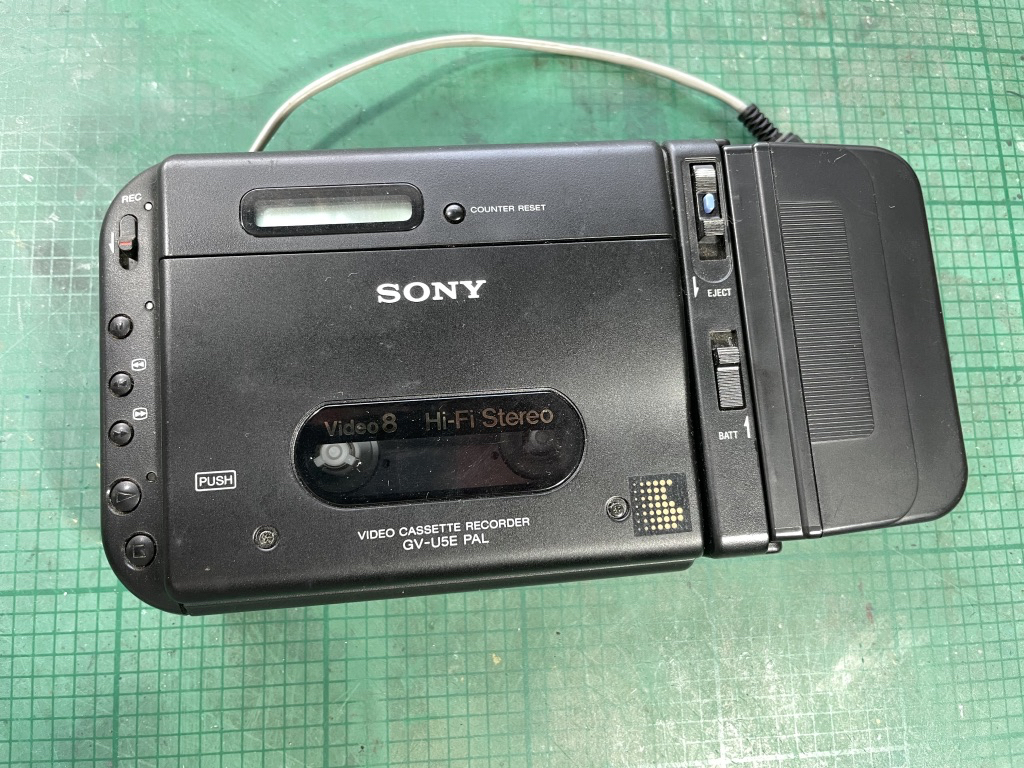
Best Beloved made a microphone pre-amplifier that sat between a pair of mono Sennheiser MK300 shotgun mics and the stereo line input on the GV-U5. We went recording ambient sound in places like the Amberley Chalk Pits Museum and local steam rallies. The audio quality, played back via headphones, was immense. One recording had the paddle steamer Kingswear Castle leaving its stage on the River Medway. The ship was some way off, and we were just playing about with the recorder behind several Historic Dockyard buildings. Kingswear Castle sounded her hooter, and the reverberation around the buildings was amazing. On another occasion, Best Beloved was behind me when I was recording, and he sneezed. Even with just the stereo pair of mics, when played back through headphones he was obviously behind the listener. A friend, when listening to that recording, actually looked round to see where the sneeze came from!
Editing was still a step too far, though. Playback from the GV-U5 was analog stereo line out, played in real time, and we still didn’t have computers, let alone software, quite capable of handling the load. The same problem affected the next step up: digital audio tape.
You see, Best Beloved was very keen to get a system that could record as many kilohertz as possible. 16-bit 48 kHz was the cat’s miaow. The DAT system could do it.
Sony developed DAT in 1987, after two standards for digital audio tape had been agreed. Sony went with a rotary head, R-DAT, like video recording systems, which allowed a high-density recording on the tape. Best Beloved did his research, and as he wanted a portable system, decided on the Sony TCD-D7 DAT Walkman. Proper professional level achieved.
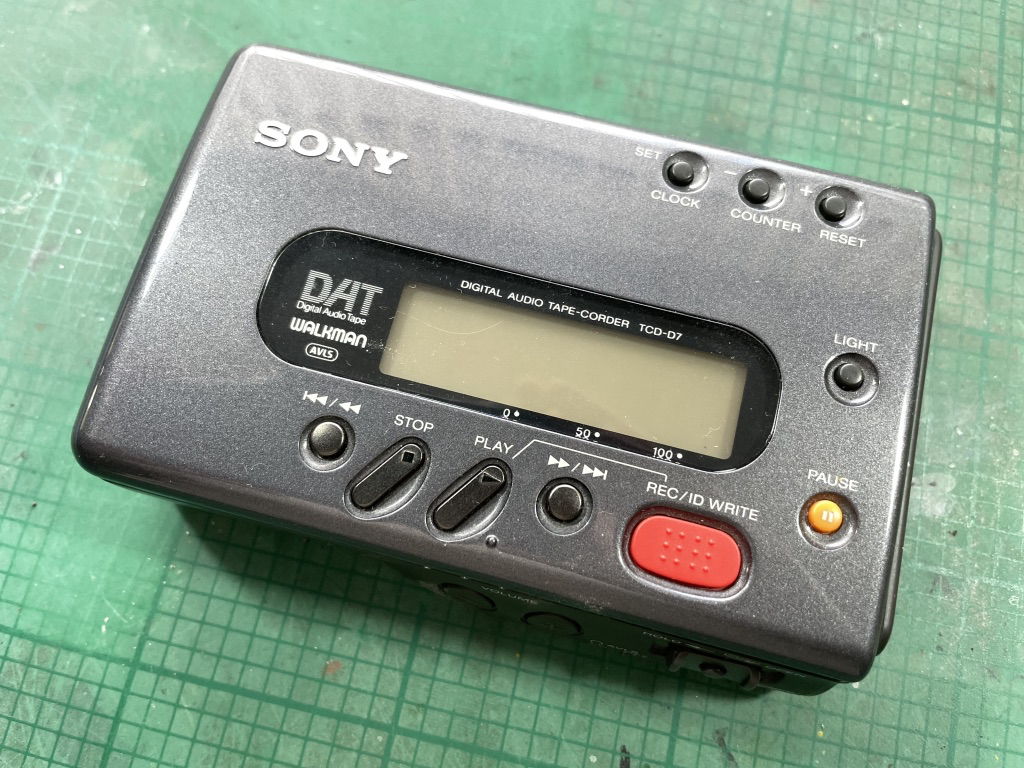
I have to admit, some thirty years on, it’s still a marvellous bit of kit, although it still has downsides. First, it’s very thirsty and can only run on four AA batteries for about half an hour. Second, the machine feels rather delicate. Changing a tape is a finicky affair, involving a ballet of mechanical parts. I wouldn’t like to switch tapes on a rainy day. Thirdly, like the GV-U5, playback is linear. There is no file to retrieve, it must be played back in real time – and the output is analog. I believe the big hifi DAT unit had optical in and out, but the portable was analog. Still, the sound recording with a decent stereo mic was outstanding, just like the GV-U5.
Meanwhile, I had gone a slightly different route. I like quality recording, but I am not as obsessed by the bit-rate or kilohertz. In the early 1990s, Sony had come up with a compact magneto-optical disc system they dubbed MiniDisc. This promised much, with portables, mains-powered units to fit in your hifi, and even car stereo head units. We acquired all three! For the purist, the system was regarded as bad, because it essentially threw away the frequencies that the human ear simply cannot hear in order that the data would fit the disc. Sony called this system ATRAC. I admit to being cloth-eared at the best of times, but I have to admit I can’t tell an optically copied track from a CD original. As a portable unit, the MD Walkman MZ-R50 was also capable of recording with a microphone attached.
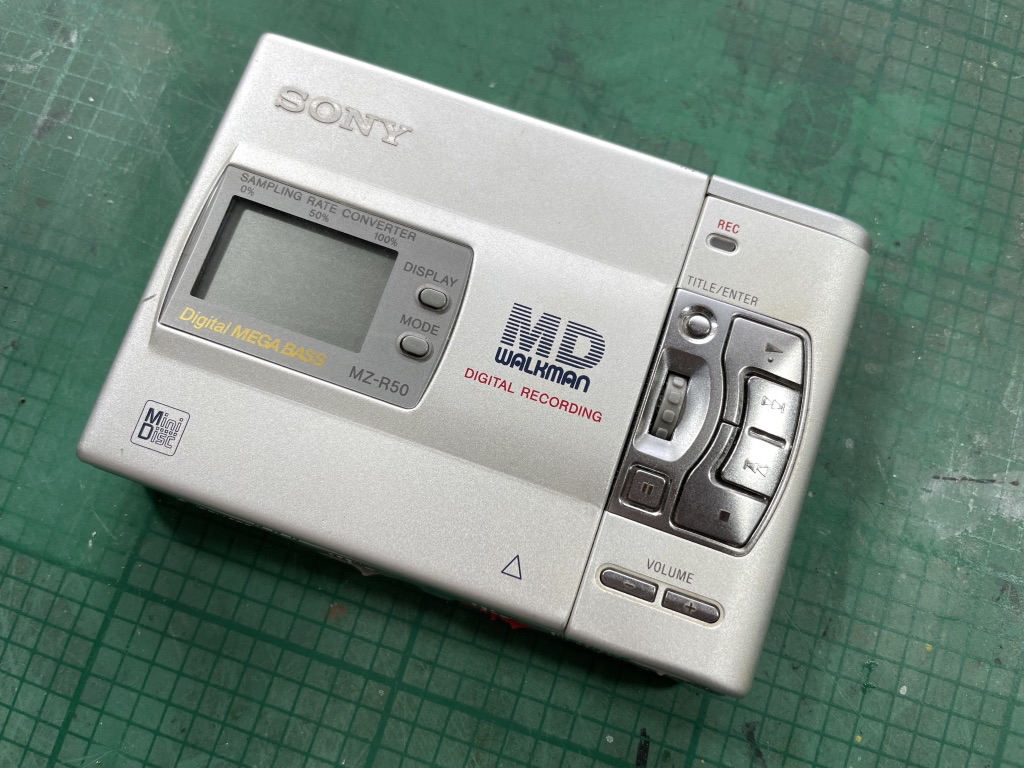
So, I had a pocket-sized machine that would run for hours on batteries that would let me record ambient sound anywhere. I thought I’d died and gone to heaven. Ah, the fly in the ointment was still getting the sound off the disc into something to edit it. Playback, even optically, was still linear. A couple of years after I got my machine, Sony developed MiniDisc units that could be attached to a PC and allow the user to copy the files back and forth, though limited to music and only working with specific software.
Again, though, life got in the way as the new millennium dawned. The MD and DAT recorders were shelved as photography became a much more interesting hobby. In the background, though, technology was still getting better and better. Solid state, recording to tiny cards instead of clumsy tapes or discs, was beginning to come of age.
I found what I wanted. It was a small device made by a Japanese company called Zoom. It was essentially a pair of high quality microphones attached to a battery pack, with some electronic gubbins that allowed it to record very high quality sound on to small SD (secure digital) cards. A pair of AA batteries could run the thing for days on end. The card could be taken out, or the unit connected to your computer, and the files could be copied across and opened in an editing software.
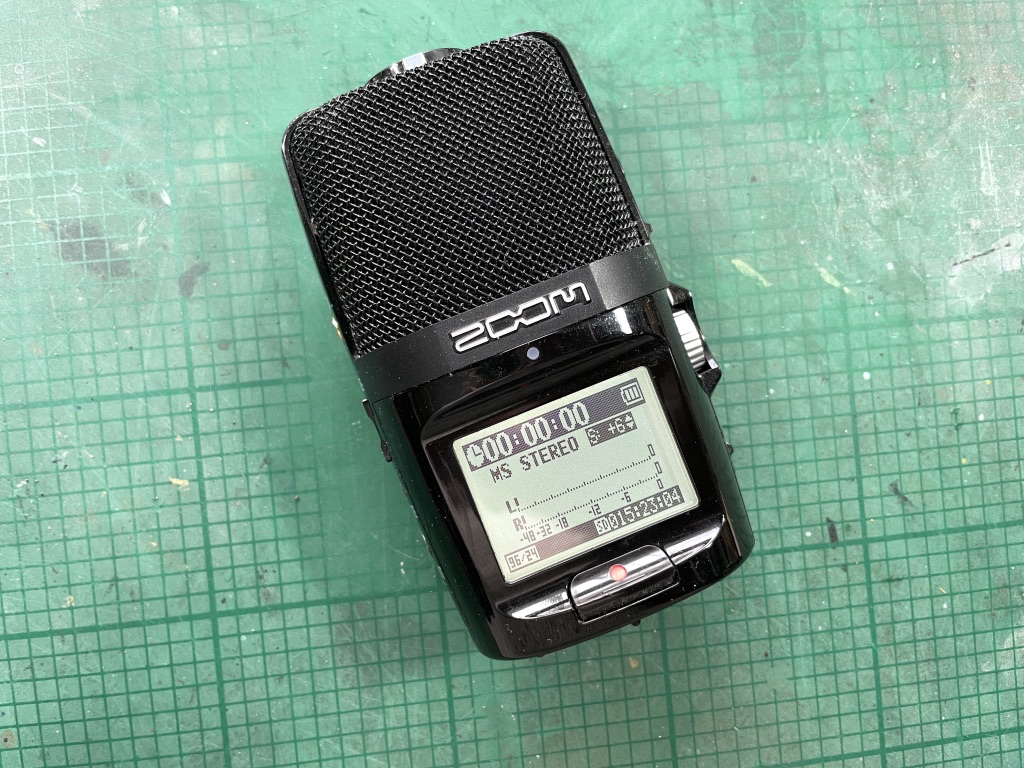
The Zoom H2N is one of a family of small audio recorders. It’s about the size of a large electric shaver. I won’t go into all the capabilities, but let’s just say it’s plenty good enough for what I want to use it for, and the results have proved too much for my lexicon of superlatives.
I have finally managed to find a piece of equipment, relatively inexpensive equipment too, which does one thing that I want it to do incredibly well. I can now go out and make ambient recordings in the field using one box that fits in my pocket, runs all day, and provides quality audio recordings of which I can be proud. My journey, in one sense, has ended. In another, it’s just beginning.
By way of rounding this off, here’s a link or two to my YouTube channel.
I’ve started to upload some of my recordings there, so grab some headphones and go and listen. You will also find an audio diary I began in 2020, which got curtailed due to some pandemic or other. Once I’ve uploaded my archive recordings, I hope to get out and make some new ones. Ideas for subjects to record are welcomed!