
I find I’m being forced into upgrading some of my tech. I’m not sure I’m happy about this. I have touched upon this in an earlier post.
When I stopped trying to be a freelance designer and started being a freelance modelmaker instead, I let my interest in all the computers and software and stuff I needed for the former profession drop. It wasn’t relevant to my work any more. I didn’t need to know about the newest and shiniest. While the interest was still there, I was a more distant observer of developments.
I am actively planning a new Mac purchase. There’s nothing actually wrong with my current machine. It’s a Mac mini, and the top of the range when I bought it all those years ago. There’s nothing actually wrong with the thing. It still works fast enough, its hard drive is nowhere near full, it has gobs of RAM. The sad fact, though, is it’s old enough for Apple to no longer offer operating system and security updates.
Of course, I could just keep the Mac going. It is, after all, still functioning. However, I’m increasingly finding some web sites break, I worry a bit about security online, my iPad and iPhone – both still currently being supported by OS updates, mind – are on the cusp of no longer being able to sync with the Mac, and there’s a new version of the Affinity software suite out there that won’t run on the current set-up. Rather against my will, I’m being left behind.
(I should say that most of my day-to-day interactions with the online world are done with my iPad. I do, though, like the desktop Mac for heavy duty text and image editing. You can’t beat the accuracy of a mouse and a huge screen!)
Yes, I am disappointed that a perfectly usable computer is about to be sidelined. I am, though, a bit excited about the prospect of a new machine.
Oddly, I don’t feel such pressure with my photography gear.
I own a Canon EOS 7D. It’s about a dozen years old now, older than my Mac. It’s absolutely perfectly fine for everything I need a camera to do. It is almost literally bulletproof, has enough features to keep me occupied – I still don’t know what some of them actually do! Numerous settings and buttons can be customised. It produces image files plenty large enough for my purposes. I have accessories that work with it.
If it has downsides, it’s like a lot of technology these days. It’s old. The ISO and noise handling isn’t as good as more recent cameras. It uses clunky CF memory cards rather than the smaller SD cards. The battery packs don’t hold quite the charge they did when new.
But it still does everything I need from a camera.
When I bought the 7D, I already had a fair collection of compatible lenses. I made a point of purchasing a spare battery. I acquired a wired remote unit, and later an infra-red shutter release. When I had a windfall, I bought the Canon battery grip, just to make the thing even bulkier! I wish I’d bought the mains-to-DC adaptor unit when I had the chance (more on that later).
More recently, I decided to purchase a compact digital camera. I ended up with a Canon PowerShot SX720 HS, with an impressive optical zoom, 20 megapixels and full HD video capabilities. I’d like RAW files for processing, but can live with the rather nice JPEGs it saves, assuming I don’t need to do much post work on them. It doesn’t have a viewfinder of any sort, reliant on the LED on the back for framing and so on. I’m not a fan, but what can you do? I carried it around with me until I replaced my ancient cell phone with an iPhone. I don’t need to carry two cameras with me on a daily basis, after all!

I do have a problem with consumables, though. Li-Ion battery packs will only take so many cycles of recharging before capacity begins to drop. Where once I could spend a whole day out shooting with just two batteries, now I might only manage half that before I run out of juice. The last time I looked for a replacement battery pack, I found the LP-E6 packs were still available, but seemed to be listed for newer cameras. They had funny extra letters in the catalogue entries, and had extra electronics and improved capacities. I didn’t know if they were actually compatible with my old camera or charger, and I wasn’t about to spend a fair wodge of cash to find out they weren’t. I ended up plumping for an aftermarket alternative, branded for Duracell. To be fair, it works just fine, and I’ll probably buy another when one of the remaining Canon packs dies.
It turns out, though, Canon have been cleverer than I thought. Instead of upgrading battery technology and leaving older cameras marooned high and dry without the possibility of replacing battery packs, the LP-E6 battery pack, I learned on researching properly, is forwards and backwards compatible. This means, although having slightly different branding and mildly different capacities, OEM LP-E6 packs designed for the current crop of Canon cameras will actually work with my old clunker. Nice.
I thought about buying a mains-to-DC battery adapter pack a couple of years ago, but felt the three-figure price was a little excessive. Now, with much studio photography work planned, I thought it might well be time to accept the cost and get one.
Sadly, the proper Canon DC adapter unit for the 7D is no longer available. I found any number of cheap knock-offs from the Far East – but would you trust your expensive camera to a DC adapter that cost less than twenty quid? I wasn’t sure. However, I did find one listed at thirty quid, and made by a company that has quite a good reputation: Neewer. My LED panel studio lights and stands are made by the same people, and they work well. I now have a Neewer DC adapter on order. I’ll find out just how good it is – if the reviews are to be believed it’s not at all bad – and report back another time.
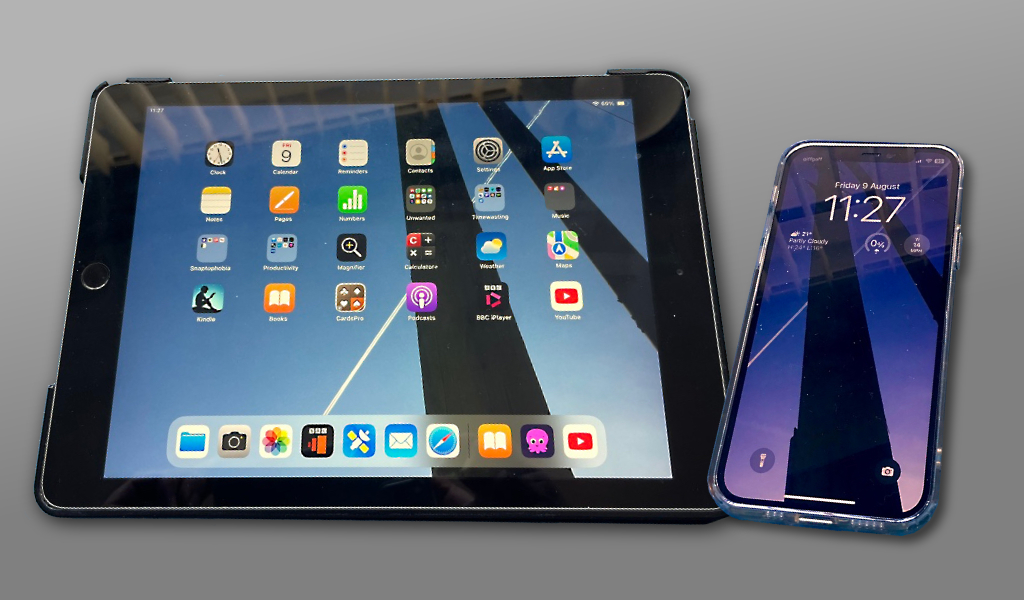
The photographic hardware landscape has changed markedly. These days, no-one actually needs a dedicated camera. We all carry a high quality camera round in our pockets or purses, capable of capturing high-definition video as well as stills. I use my iPad and iPhone for taking progress photos of work on my bench. Being able to quickly edit and upload to the world wide web on a single device is a boon.
Using my phone as a camera indoors is fine, but peering myopically at the highly reflective screen at arm’s length on a bright sunny day is not something I find easy – and don’t even talk about trying to do outdoor photography with an iPad! Give me a nice optical viewfinder every time!

I use this image as wallpaper on my phone and tablet. I am still amazed at its quality. There’s a lot of detail in the silhouetted poles, for example. I snapped it on a chilly February morning in 2017, with the back camera on an Apple iPod touch. The file is an 8 megapixel JPEG file, weighing in at just over a megabyte, and I can guarantee it has not been edited in any way since it was taken. It just proves, really, that the best camera is the one you have with you!
I have long ago overcome my GAS (Gear Acquisition Syndrome). While new and shiny is always nice, and a new Mac is definitely on the cards, I really don’t feel I need to replace my 7D. It may well outlive me!
Funny old world.