I started to get seriously into digital photography at the start of the 2000s. My first digital camera (should there be a ™ after that?) was a little Fuji compact thing. It didn’t cost much, but was fun to play with. Eventually, I persuaded Best Beloved that I should move up to something a bit more serious.
The obvious upgrade path was to a digital SLR. The obvious problem there was the technology wasn’t quite hitting its stride, and the other obvious problem was such things were still eye-wateringly expensive. I had read a review or two, and felt the best move up from a compact was to a Minolta Dimage 7. Out on the town one Saturday, with Best Beloved in tow, I suggested we have a look in the better of the town’s camera shops — remember them? — and if they had a Dimage 7 in stock I would like to have a play with it. Well, there was a promotion on, and the discounted price was too good to miss.
We walked out of the shop with a Dimage 7.
The Dimage 7 had a heady 5.1 megapixels. That sounds paltry these days, but back then it was much more than even the high-end professional cameras could manage. Full manual controls, a decent optical zoom, and the ability to save to a native TIFF instead of JPEG. It did have its downsides, though. It liked batteries. Four AA batteries would be eaten in very short order. I carried a bag full of freshly-charged cells. The viewfinder was electronic, and not terribly high resolution, while the rear screen was also pretty poor. The camera was slow to start, so you’d sometimes missed a shot, autofocus was also sluggish and often failed to hit the mark. The images it captured, when it got it right, were lovely.
Of course, I still lusted after a digital SLR. The technology was evolving quickly, and the big names in the game were Nikon and Canon. The issue was cost. Not only would I be buying into a whole new camera ecosystem, I would need to spend money on lenses and other peripherals.
I kept watching.
Anyway, Canon were first to get into the DSLR “prosumer” market, with the EOS 300D. Soon, it was the 350D, then the 400D. These names may mean little to you if you live outside Europe. Perhaps Digital Rebel is easier? Whatever, the market had almost reached the level where I was able to buy into it.
DP Review was the go-to online review site. The people that ran the site knew what they were about. They had standardised tests they would perform on new camera gear, so it was possible to compare and contrast between models and brands. My choice came down to Canon and Nikon, and I found the EOS 400D just edged it in the quality of the straight-out-of-camera JPEG. Okay, I still lusted after a full-frame DSLR, but was content to start with the crop-frame sensor until I could afford to upgrade.
My mind was made up.
Another trip to the town, and to another camera shop. This shop was selling an EOS 400D kit, in a special metallic body colour, no less, at a very good price.
We walked out of the shop with a Canon EOS 400D and kit lens.
And so, my interest in digital photography took another boost. As and when I could afford to I bought new glass. I bought an intervalometer, basically a posh wired remote control. I bought an angle-finder gizmo that clips to the viewfinder so I could look down into the camera instead of having to grovel in awkward locations. I took thousands of photos.
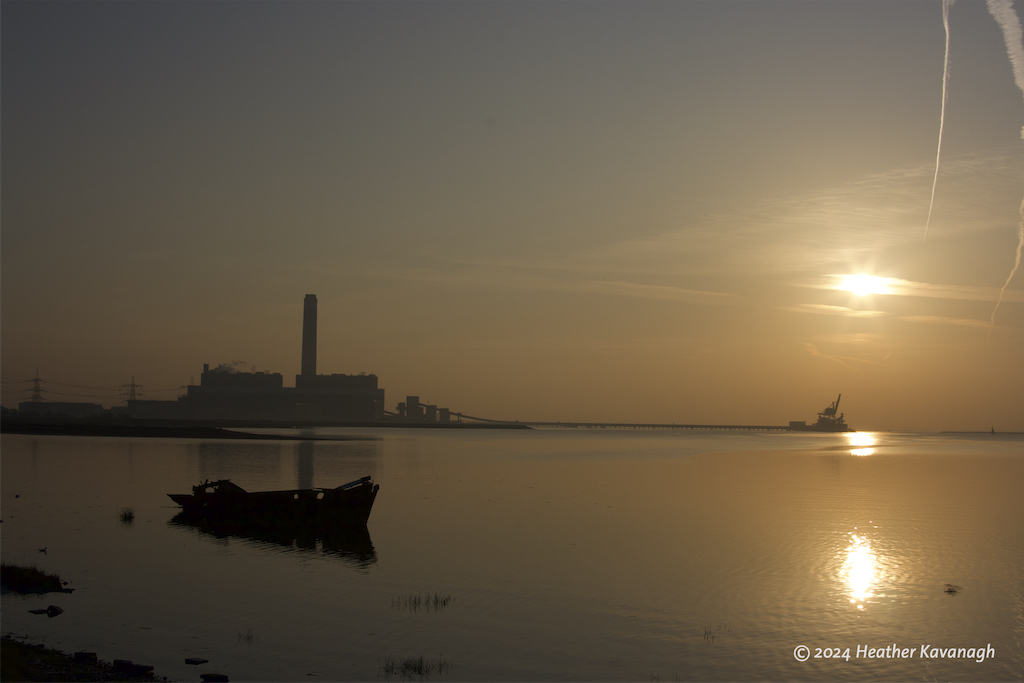
Unsurprisingly, I found I was editing the files more than I expected. JPEGs don’t take too kindly to being over-edited, so I soon learned about capturing RAW files. I never looked back — until recently.
Don’t worry, I am getting to the point!
Best Beloved and I took a week’s holiday in York. Plenty of opportunities, if the weather was kind, for landscape and architectural photography. We discovered there was a decent camera shop in the city.
I had been learning about a new compact camera from Canon. It had a lot of manual controls, professional features, such as a proper hot shoe that worked with all the current flash gear, and could shoot RAW files. If they had one in the shop, I mused, perhaps we might have a look at it. I didn’t plan on buying it, because it was, well, quite expensive, and I wasn’t really all that well off at that stage. I had, though, been considering another compact camera that would fit in my handbag and be half-decent to use when the bigger 400D and lens was too much to lug about. It happened to use the same battery pack as the 400D, coincidentally. All this was said with a dead pan face, obviously.
We walked out of the shop with a Canon PowerShot G9…
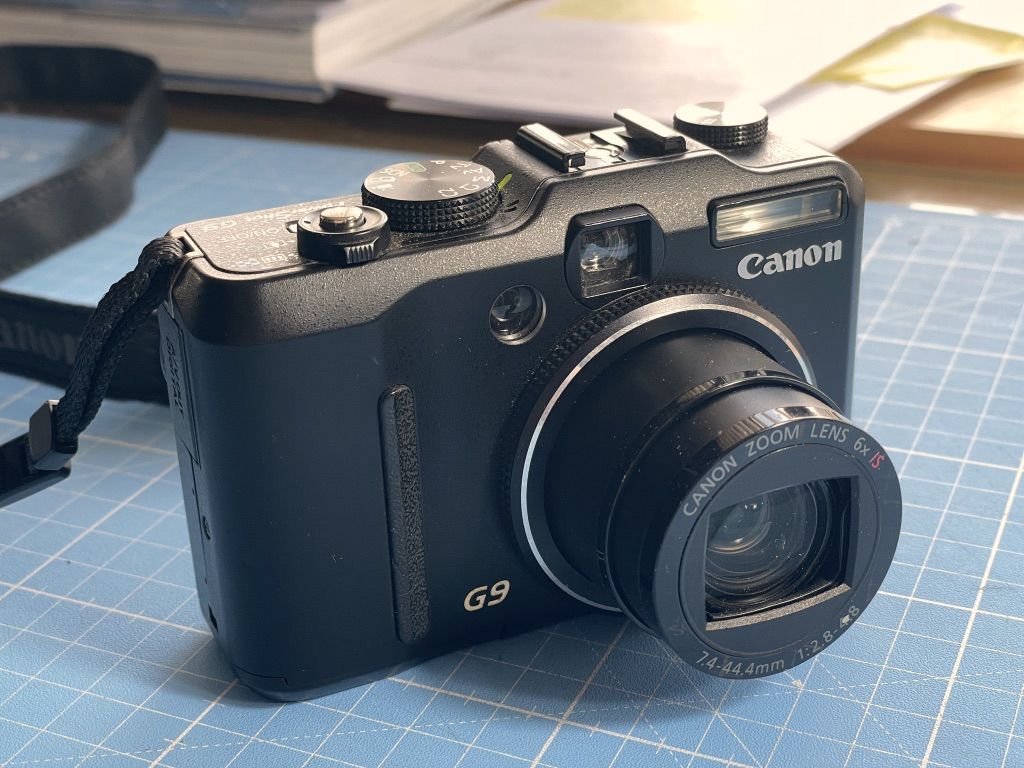
That was 2009. The G9 was soon eclipsed by upgrades, but it still held its own. The EOS 400D was a 10 megapixel camera, the G9 was 12 megapixels. This was a time when the megapixel race was still under way.
The little G9 got a lot of use. It was the ideal camera for walking about with. Out visiting places, Best Beloved could use it while I wielded the DSLR. While a little small for my hands, it was comfortably, perhaps even reassuringly heavy. You felt it could handle a drop or knock, and not break.
I eventually saved my pennies and was able to upgrade the 400D to a 7D body. All my existing glass still worked, as did all the peripherals. I sold the 400D kit to a friend who wanted to start in digital photography. The 7D was my “grown up” prosumer 18 megapixel camera, with the G9 acting as backup when out on shoots.
A while later, a friend gave me a smaller PowerShot 110. It was tiny yet captured RAW files, but did some things the G9 couldn’t, like full HD video capture. That became my carry-around, but the G9 remained for “proper” photography. Sadly, I loaned the 110 to another friend, who promptly lost it. Bother. I liked that little thing.
Feeling I needed a camera that could handle HD video capture — though not certain why — we went shopping again. This time we ended up with a PowerShot SX720 HS. I think you’ve met it here before, so I won’t bore you with a link. It’s a capable box, 20 megapixels, full HD video, wifi enabled, and a frankly pretty amazing 40x optical zoom. Plenty of manual controls, once you work out which multifunction button does what. Downsides? It only captures JPEG.
I like capturing RAW images. If you don’t know, RAW is literally everything the camera’s sensor captures. You need to process the file to get an end result, though that sounds far more complicated than it actually is. JPEG is a lossy format, which means it saves file size by throwing away bits of the image which don’t matter. Every time a JPEG is edited, it loses more data, and very quickly can end up being useless. Happily, the SX720 is actually pretty good at saving nice JPEGs, so with care very little post-processing is required.
However, I like RAW files. I like the ability to go in and change the white balance, to bring out the details, to actually process an image to get the best from it.
We had loaned the G9 to a friend. A couple of weeks ago, I wondered if he might be persuaded to take the SX720 and let us have the G9 back. It turns out, while all this camera shenanigans has been going on, the mobile phone world has taken over the sort of photography that our friend was doing. He didn’t actually use the G9, so was quite happy to return it. Phones are also capable of capturing full HD video, too, and as I have finally got up to speed with smartphones the SX720 was sort of surplus to requirements.
And so, after that long and tiresome back story, I am able to say “Well, hello old friend”. The G9 is back in my camera bag, and I look forward to using it in anger again. I have missed it.
Thank you, if you have managed to make it this far. I didn’t quite expect to ramble on as long as I did. That’s the problem when I think I need to make a blog post, but don’t really plan it out to any degree. What you have just read is almost literally straight off the top of my head, with a bit of archive digging to find ancient digital images.