Leonard Paul Prior, 1939–2025

A year ago, I was widowed. Paul, my partner, companion and lately husband, died. It’s taken me a year to begin to cope with rebuilding my life without my life partner of over thirty years.
But, this isn’t about me. This is about Paul.
Leonard Paul Prior was born in the London Borough of East Ham on 6 November 1939. A few years ago, we discovered the house he was born in, 28 Kennard Street, was still there, having somehow survived the Blitz and subsequent rebuilding of the area — including the building of London City Airport. Paul’s father, also called Leonard, worked in the Tate & Lyle sugar refinery. It isn’t recorded what Nellie, Paul’s mother, did for work. I assume, as was fairly typical for the time, she was a housewife, and now a mother.
At some point between Paul arriving and the start of the Luftwaffe bombing London in the autumn of 1940, the family moved to the border of Buckinghamshire and Northamptonshire, to a village called Haversham, not far from Wolverton. It’s possible Nellie and her infant son were packed off to safety as part of the evacuation schemes, with Len following on a little later. Nellie kept the house, brought up baby, and served in the Women’s Voluntary Service. Len found work in the Wolverton Carriage & Wagon Works of the London, Midland & Scottish Railway.
Paul grew up in what was then a rural environment. Nowadays, the area is mostly contained within the city of Milton Keynes. He attended the local primary school, passed the 11+ test and went to Wolverton Grammar School. You can read all about his old school blazer. He enjoyed his school years, showing aptitude for the sciences and maths, and cross-country running. Paul’s father was a bit of a dab-hand with electronics, and built a television receiver from a kit of war surplus radar parts. Paul would continue that interest for the rest of his life, becoming a licensed radio amateur very early on. His first call sign was G6ANS, later becoming G8IXC.
As the biggest employer in the area, and with his father already working there, Paul entered the railway works after leaving school. Not quite an apprentice, he moved around all the different departments to gain experience, and to find out where he would best fit. At some point, his knowledge of electronics was noted. The works manager asked if Paul might take a look at the wireless set in the Midland Region Royal Train, which was usually kept and maintained at the works. Her Majesty, apparently, had complained of crackling noises. The problem was soon cured, but Paul always joked that he was still waiting for his MBE!
Model railways were also an interest for Paul and his father. An O gauge layout was built along one side of the garden, electrically powered and properly signalled. The interest in railway signalling — and model railways — stayed with Paul until his death. While he was apprenticed at the Works, he applied to enter the British Railways signalling school. He wasn’t successful, for reasons I never discovered. Once his apprenticeship was completed, Paul left British Railways and signed on with the British Army Royal Signals Regiment in the late 1950s.

Once his training was over, Paul was posted to Krefeld, in what was West Germany. He was responsible for radio communications for that sector of the BAOR (British Army of the Rhine). He told me many stories of his time there. He became fluent in German, and made good friends with a local family — and their eldest daughter!

Paul was demobbed in 1964, and returned the UK where he took up a teaching post at the Royal Signals training school at Catterick in Yorkshire. Meanwhile, his parents had moved from Haversham to Hornchurch in Essex. While Paul enjoyed his military service, and the time he was training new recruits, in some ways he always regretted coming back to England.
Civilian life saw Paul working for an Essex-based electronics firm. He was always a bit cagey about this period of his life, as I think the job he officially held was more a cover for secretive government work. I shall therefore, like him, gloss over this period. He was later head-hunted by another firm to work on audio teaching aids, and later still worked with a company that manufactured high quality microphones. This led Paul into meeting some famous names in entertainment, including Max Bygraves. He also became very good friends with the actor Victor Maddern.
All of this was well before I knew Paul, of course.

A telecommunications company in Rochester, Kent, persuaded Paul to join their ranks as Senior Development Engineer. In 1981, Paul and his mother, Nellie, moved to the Medway Towns. It was at the end of the 1980s that Paul and I first met, at a local model shop in Rochester.
Paul had built a couple of O Gauge model railways that he exhibited at shows. Befitting his interests in electronics, both layouts were quite advanced for the time. The smallest, called Linford Shed, was entirely automatic. Four model locomotives would be placed on the layout, and a switch thrown to start the sequence. The locos would slowly move about the layout, in and out of the shed, up sidings and so on, without any human intervention, much to the bemusement of the onlookers! Paul and I attended many exhibitions around Essex and Kent, and became known as The Linfords.
Eventually, after one year where we had attended 14 exhibitions in quick succession, we realised we didn’t really have time to make repairs or build new stock any more. We stopped attending shows, and made plans for one final great layout. A large shed was erected in the back garden, and a design for a through station with lines looping out into the garden was drawn up. Paul built the trackwork, and made headway on station buildings based on the original Wolverton station, near where he grew up.
Sadly, Paul’s eyesight began to fail quite quickly, caused by age-related diabetic retinopathy and macular degeneration. I wasn’t capable of wiring the trackwork and installing the control and signalling system. Paul simply wouldn’t have been able to check my work, and I knew that would be most frustrating for him. We reluctantly agreed to stop the build.
Instead, Paul arranged for a high spec PC to be built, and he contented himself playing with a train simulator. He built lots of interesting virtual layouts, mostly involving complex signalling — his first true love.
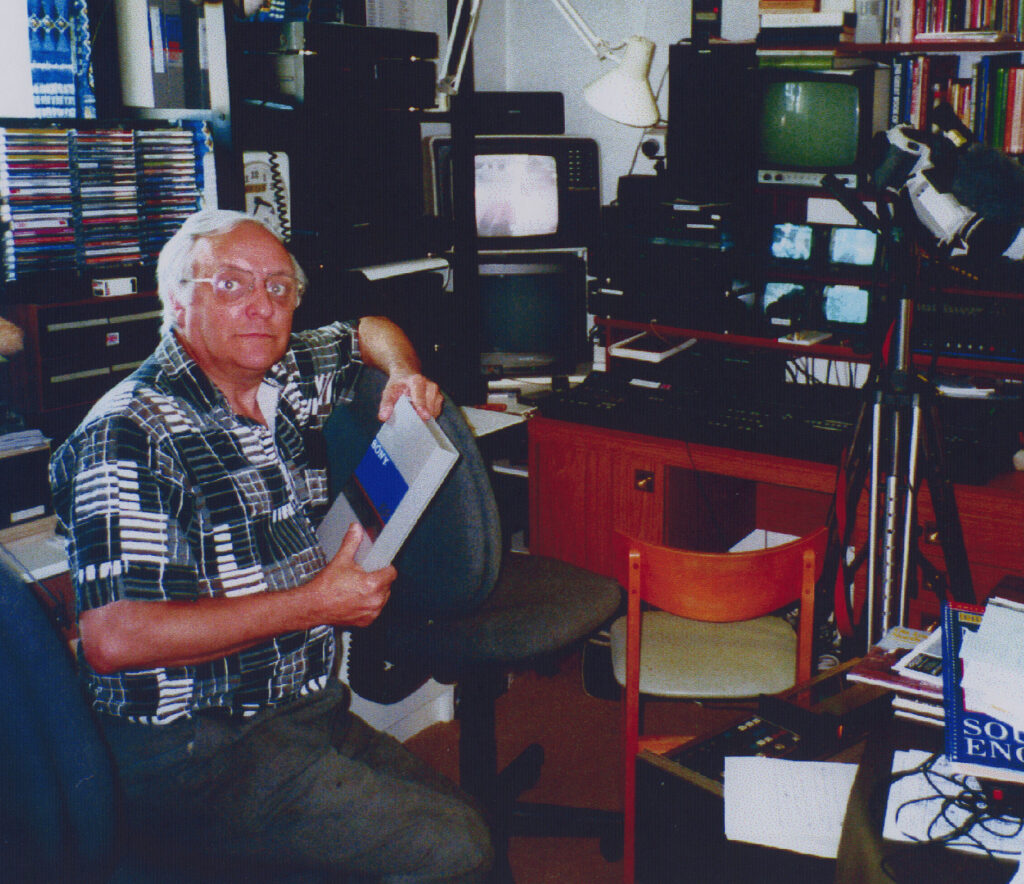
Paul maintained a keen interest in amateur radio throughout his life. As well as audio, he was a member of the British Amateur Television Club and Kent Television Group (now closed) for many years. I bet you didn’t know amateur radio licences also allowed for TV broadcast.
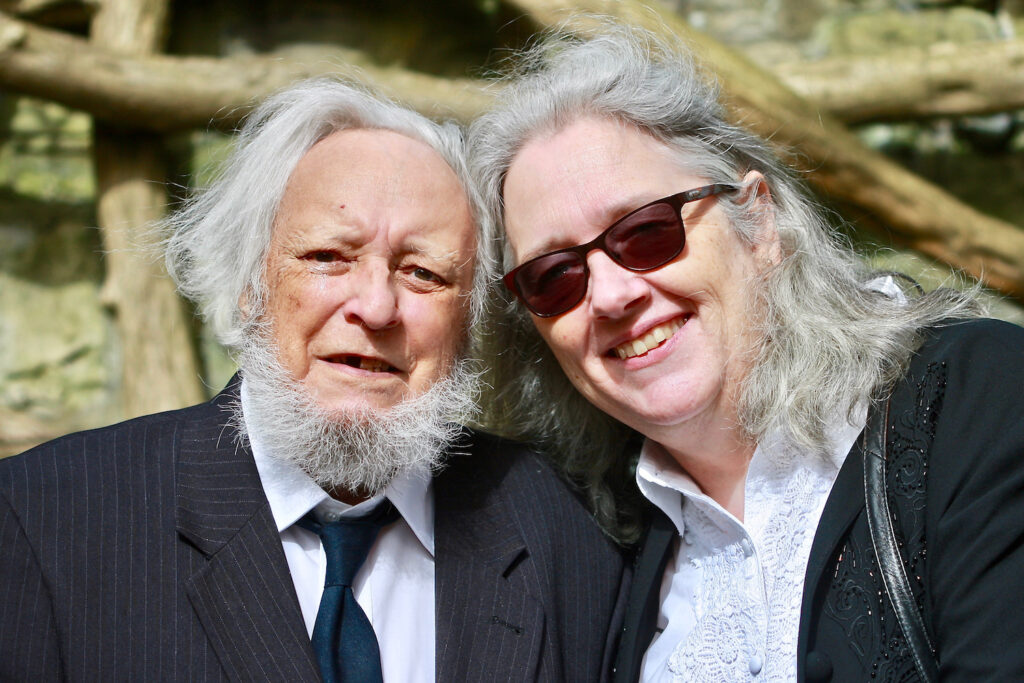
Paul and I had been a couple since 1989. I moved in to live with him after Nellie died in 1996. As his health declined, we decided we should make the arrangement all proper and legal, so we got married on 1 April 2021. As I’ve recounted elsewhere, I became a carer, and was with Paul at the end. Paul died in the early hours of Thursday, 6 February 2025. He was 85 years old. A clever, inventive, kindly and loving man, he is still sorely missed.
(As an addendum, I persuaded Paul to talk about his early life and other experiences. I have the recordings, but I haven’t had the courage to listen back to them. When I do, I may be able to add further information about Paul and his interesting life.)